Study in Spain from Pakistan: Costs, Scholarships and Student Visa (2026)
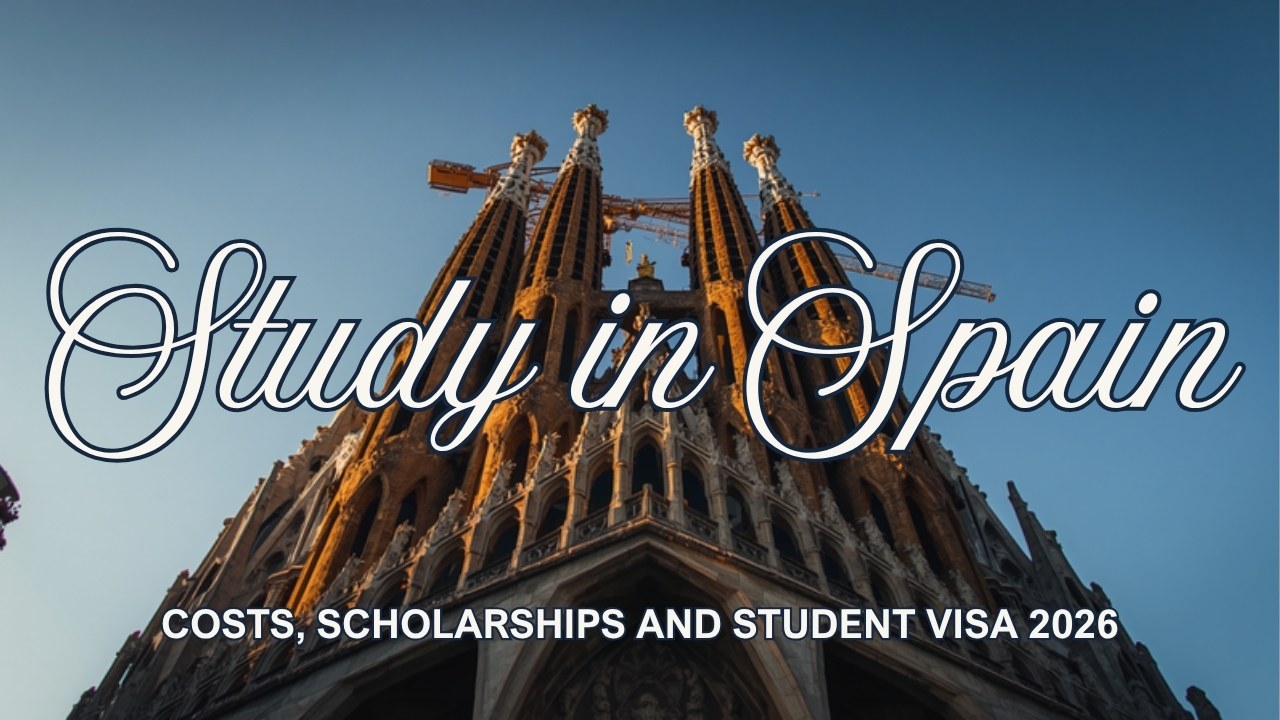
Table of contents
- Why do Pakistani students choose Spain?
- How much does it cost to study in Spain?
- What scholarships can Pakistani students get?
- How do you get a Spain student visa from Pakistan?
- Can you work while studying in Spain?
- What can you do after you graduate?
- Top universities for Pakistani students
- Step by step: how to apply
- Frequently asked questions
Why do Pakistani students choose Spain?
Spain sits in a useful middle ground. It gives you a degree from inside the European Union, but the cost is far lower than the UK or the United States. A public university here can charge less for a full year of tuition than a single semester at many British universities. For a family in Lahore or Karachi watching the rupee, that gap matters.
There is also the question of life outside the classroom. Spain has long summers, cheap public transport in the big cities, and a student culture that runs late into the evening. The food is affordable if you shop at local markets, and the country is well connected to the rest of Europe by budget airlines, so weekend trips to France, Italy or Portugal are realistic on a student budget.
One honest point: a lot of teaching at public universities happens in Spanish. The number of English taught master’s programmes has grown a great deal, especially in business, engineering and data fields, but at bachelor level you will find more choice if you can study in Spanish or are willing to learn it. We talk more about that below. If you want to compare Spain against other European options, our guide to studying in Italy and the Germany route are worth a read.
How much does it cost to study in Spain from Pakistan?
Your total cost breaks into two parts: tuition and living. The tuition number swings widely depending on whether you pick a public or a private institution.
Tuition fees at public and private universities
At public universities, non EU students often pay more than local students, but the figure is still modest by Western standards. A bachelor’s degree at a public university tends to cost between EUR 1,000 and EUR 3,500 a year. Public master’s programmes usually run from EUR 1,500 to about EUR 4,000 a year, though some specialised courses charge more. Fees are calculated per credit in many regions, so the exact bill depends on how many credits you take each year.
Private universities and the well known business schools are a different story. Places like IE University, ESADE and IESE charge EUR 12,000 to EUR 30,000 or more for a year, and they market themselves to an international crowd. They offer strong job links, but you pay for that access. For most Pakistani students chasing value, a public university gives the better return.
Cost of living in Spain
Where you live changes your monthly budget more than anything else. Madrid and Barcelona are the dearest cities, where a shared flat, food, transport and phone can add up to EUR 1,000 to EUR 1,300 a month. Cities such as Valencia, Granada, Seville and Salamanca are far gentler on the wallet, often EUR 700 to EUR 950 a month for the same lifestyle. Student accommodation, called a residencia, costs more than sharing a private flat with other students, which is what most people end up doing after the first term.
What scholarships can Pakistani students get?
Spain does not run one single famous government scheme for international students the way some countries do, so funding here is a mix of several smaller routes. The MAEC-AECID scholarships, run by the Spanish foreign ministry, support a range of postgraduate study and research for students from countries including Pakistan. They are competitive and the categories change each year, so check the current call before you build your plan around them.
Erasmus Mundus joint master’s degrees are often the strongest option. These are funded by the European Union, many of them run partly in Spain, and a full award covers tuition, travel and a monthly living allowance. You apply directly to the specific programme, not to Spain as a country. Beyond these, individual universities offer their own merit and need based grants, Santander runs scholarships for students at partner universities, and some regional governments fund places too. Our list of fully funded scholarships for Pakistani students covers several of these in more detail.
How do you get a Spain student visa from Pakistan?
Because a degree in Spain lasts longer than 90 days, you need the national long stay student visa, known as the type D visa. You cannot study on a tourist Schengen visa. You apply once you hold an official acceptance letter from a recognised Spanish institution.
Documents you need
The core file is fairly standard. You will need your acceptance letter, a valid passport, proof that you can pay for tuition and living costs, private health insurance that is valid in Spain with no co payments, a clean police character certificate, and a medical certificate confirming you carry no diseases listed under international health rules. Documents issued in Pakistan usually need attestation and a sworn translation into Spanish. Build in time for this, because the attestation chain through the relevant ministries and the consulate is slow during peak intake months.
Financial proof and the IPREM
Spain measures the money requirement against a figure called the IPREM. For 2026 the monthly IPREM is EUR 600, and a student must show 100 percent of it for each month of stay. For a twelve month course that comes to about EUR 7,200. If a family member travels with you, you add 75 percent of the IPREM for the first relative and 50 percent for each one after. If you have already paid for your accommodation for the whole stay, you can deduct that amount from what you need to show. You can prove funds through bank statements, a scholarship letter, or a sponsor who supports you, and our guide on how much bank balance you need explains how to present this cleanly.
Not sure if Spain fits your budget and grades?
Tell us your degree, your marks and your budget, and we will tell you honestly whether Spain is your best move or whether another country gives you more for the same money.
Can you work while studying in Spain?
Yes, and the rules recently improved. Students enrolled in higher education, which covers university degrees, master’s programmes and vocational training, can now work up to 30 hours a week. For most university students this work permission is built into the student visa, so you no longer need a separate work permit application the way students did in the past.
The catch is that the job must not clash with your class schedule and your studies have to stay on track. Many students work in hospitality, tutoring, retail or as part of internships tied to their course. During holidays you can work full time. A part time wage will not cover all your costs in an expensive city, so treat work as a top up rather than your main funding plan. For a wider view, see our country comparison of part time work rules while studying abroad.
What can you do after you graduate?
Spain lets graduates stay on to look for work or to start a business. After you finish your degree you can apply to change your student permit into a job search permit that gives you up to twelve months to find a role linked to your qualifications. Once you have a job offer, you move onto a work residence permit.
Spain has also made it easier in recent years for graduates of Spanish institutions to move into skilled employment, and time spent legally in the country counts toward long term residence later. If your main goal is a clear path to staying in Europe and working, read our roundup of the best countries with a post study work visa so you can weigh Spain against the alternatives.
Top universities in Spain for Pakistani students
Spain has a deep set of public universities with long records and a handful of private institutions that rank well for business. Among the public names worth shortlisting are the Complutense University of Madrid, the University of Barcelona, the Autonomous University of Barcelona, the Autonomous University of Madrid, the Polytechnic University of Catalonia for engineering, and the Polytechnic University of Valencia. The University of Navarra and the private business schools IE, ESADE and IESE carry weight in management and finance.
Pick your university around the specific programme and the language it is taught in, not just the overall name. A strong master’s in your field at a mid ranked public university often serves you better than a famous name in a course that does not match your career plan. You can see the full set of countries we help students with on our destinations page.
Step by step: how to apply
The order of events matters, because the visa cannot start until the admission is settled. Here is the path most students follow.
First, shortlist programmes that fit your field, your budget and the language you can study in. Second, check the entry rules for each one, since some master’s courses ask for a recognised bachelor’s and proof of English or Spanish. Third, prepare your statement of purpose, transcripts and reference letters and apply for admission. Fourth, once you hold the acceptance letter, get your documents attested and translated, arrange your health insurance and funds, and book your visa appointment through BLS International. Fifth, attend the appointment, submit biometrics, and wait for the decision. Once you land in Spain, you register for your foreigner identity card, the TIE, within the first month.
If you want a general view of the visa process before you start, our step by step student visa guide walks through the common stages for any country.
Frequently asked questions
Can I study in Spain without learning Spanish?
Yes, at master’s level there are many programmes taught fully in English, especially in business, engineering, computer science and international relations. At bachelor level your choice is wider if you can study in Spanish. Even in an English taught course, basic Spanish helps a great deal with daily life, part time work and making friends.
How much money do I need to show for the Spain student visa?
For 2026 you must show 100 percent of the monthly IPREM, which is EUR 600 a month, for each month of your stay. A full twelve month course works out to around EUR 7,200. If you have prepaid your accommodation, you can deduct that from the total you need to prove.
Is IELTS required to study in Spain?
For English taught programmes, universities usually ask for proof of English such as IELTS or an equivalent, though some accept previous study in English instead. For Spanish taught programmes they may ask for a Spanish language certificate like the DELE. Always check the exact rule for your chosen course.
How long does the Spain student visa take?
Processing commonly takes a few weeks to a couple of months, and it gets slower during the busy summer intake. Start your document attestation early and book your appointment as soon as you have your acceptance letter, because delays here are the most common reason students miss their start date.
Can my spouse come with me to Spain?
Family members can join you, but you must show extra funds, adding 75 percent of the IPREM for the first family member and 50 percent for each additional one. There are specific dependent visa steps to follow, and your spouse may be able to work depending on the permit conditions.
Is studying in Spain cheaper than the UK?
In most cases yes. Public university tuition in Spain is a fraction of typical UK fees, and living costs outside Madrid and Barcelona are lower than in major British cities. The trade off is that more programmes are taught in Spanish and English taught choices, while growing, are still narrower than in the UK.
Can I work full time during holidays in Spain?
Yes. The normal limit is 30 hours a week during term for higher education students, and you can work full time during official holiday periods, as long as the work does not interfere with your studies.
Do I apply to the university or to the visa first?
The university first. You need an official acceptance letter before you can apply for the type D student visa, because the visa application requires that letter as a core document.
Can I stay in Spain after I finish my degree?
Yes. Graduates can apply for a job search permit of up to twelve months to find work linked to their studies, and then move to a work residence permit once they have an offer. Time spent legally in Spain also counts toward longer term residence later.
Ready to build your Spain application?
Border and Bridges helps Pakistani students choose the right Spanish university, prepare a clean visa file, and avoid the document mistakes that cause delays. Send us your details and a counsellor will map out your next steps.